Keep calm and don’t step on gravity mines
Searching for the holy grail of physics
In particle physics the unification of gravity within the framework of electromagnetism is apparently a big thing, to the point that we wonder why shouldn’t we incorporate electromagnetism under the framework of gravity instead?
Well, to begin with, electromagnetic forces are HUGE compared to gravity, hence they were discovered and harnessed somewhat sooner.
Gravity on the other end was always a weak force, and unlike electric particles, it could not be harnessed usefully, only negotiated with in a heavy kinetic, mechanical way, like in rockets.
In fact a number of people in and out of the academia are out there preaching this or that theory of gravity, quantum gravity, electro-gravity, etc.
Most of these experiments are very complicate, very expensive, require huge amounts of energy and they would only produce small gravitational effects, so hardly the material for an AVENGER action sci-fi packed movie, and hardly within our technological capability to test these formulations.
It has however come to our attention that the usual suspects in the counter academia did indeed work a grand unification of electromagnetism and gravity since 1970, and eventually completed the job with a full working theory back in 2006.
The author of said theory selfishly decided to hide such masterpiece of mathematical perfection in plain sight and publish it in such an heavily scientific formulation to resemble the Klingon idiom, to the point that most people might not read such fundamental piece of physics, or might read it and not readily understand its implications.
On the other end it has been established beyond any reasonable doubt that the attention span standards of the average human have decayed substantially in the past 20 years.
If we then combine the huge amount of noise data competing for attention with signal data, it would sure appear that we have regressed to a state of informational dark age where too much information is as good as no information at all.
This state of affairs shall not however dissuade us from scavenging some of the simpler formulas and translate these to some plain electrogravitic applications for the general purpose of “elevating” the earthlings toward greater scientific and gravitational heights.
Gravity as a leaky electrical and magnetic field
The man hisself, Einstein once said that (for lack of simpler words) any space with non null electrical and or magnetic field also must be a source of a gravitational field.
Meaning that even if some space has no mass, but there is a tiny, stray magnetic or electric field, well those fields have an energy, hence a gravitational mass.
This is very important because we could have charges and/or their associated magnetic moment creating that stray electric and/or magnetic field that is indeed the source of energy and therefore gravitational mass.
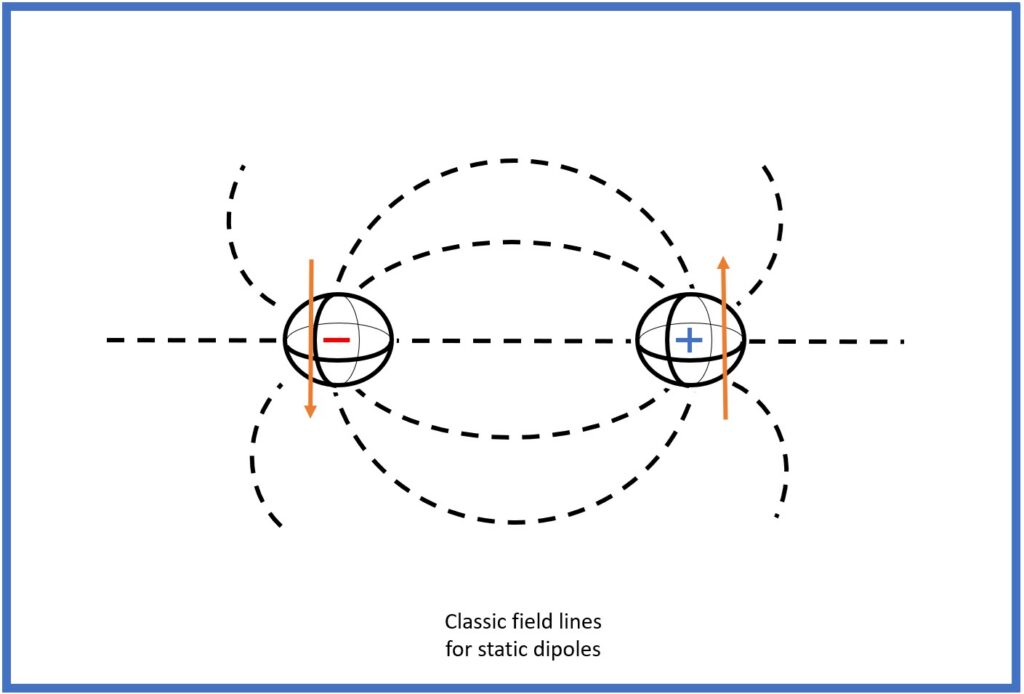
The issue with this approach is that a neutral body with no charges (like a neutron) or even a planet with lots of atoms, protons, electrons, but still overall neutral charge, should then have no electromagnetic field radiating out of it, hence should have no gravitational field at all.
In fact, even the plain electric and magnetic dipole in our figure has null electric field at long range, hence its gravitational tensor energy is also null, hence it would have no gravitational (electric/magnetic) mass (energy) at all at long range
One good thing though is that at atomic level, things are not exactly static, but they are always dynamic, meaning charges do not just sit there like a stick in the mud, but they are always bustling around and about.
Then our charge pair, in its simplest hydrogen atom form would look a bit like this:
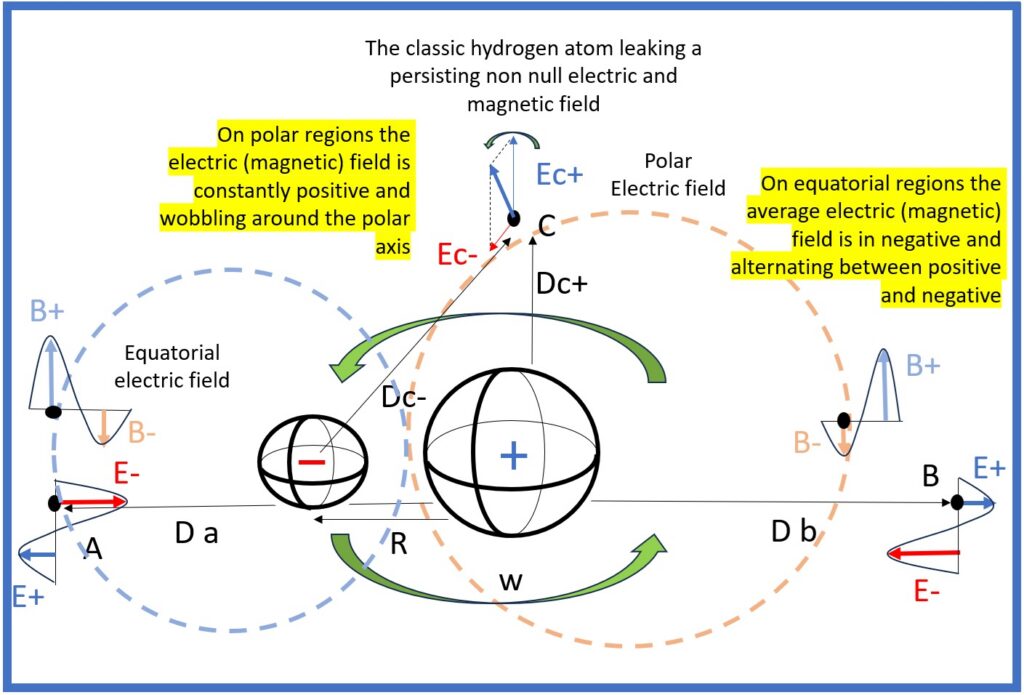
In this representation we can see that the dynamic nature of the electron orbiting around the proton, causes a persisting flickering of electric and magnetic field around the equatorial regions, which cannot be compensated by the electric field leaking from the polar regions.
So albeit the gaussian integral for both charges is still zero (meaning total electric field outside the atom is in average ZERO on a spherical surface envelope), the electric and magnetic field distribution is unbalanced and locally non zero, hence we have a small source of energy density which hasn’t completely neutered after we coupled the electron and proton together.
And because an electron doesn’t simply collapse onto a proton but stays at very specific distance from it, this electromagnetic unbalanced flickering is there to stay persistently forever without dissipating in a photon!
OBSERVATION 1: To keep in mind is that albeit this leaky electric (magnetic) field is only relevant on the equatorial plane of an atom, said equatorial plane doesn’t necessarily hold steady for long, but it keeps turning and twisting around all the time, meaning this flickering field is “broadcasted” in average on all 3D directions from the atom.
The alternating part of this leaky electric field on the equatorial plane is the active part of the gravitational field intended as an high frequency alternating electric field, which causes particles to attract like dipoles. On the other end, the polar part of the electric field which just rotates and does not alternates, as well as interactions between dipoles (particles) at mismatching frequencies, is the reactive part of the electric field which causes particles to ultimately reach a thermal equilibrium.
So now what happens when we add some energy (photons) to our hydrogen atom?
The atom total energy, hence gravitational mass becomes greater (thanks for the tip photon E = mc^2 !).
But also we can tell that as the proton-electron radius increases, also the magnitude of the electric field flickering increases by a very similar amount!

OBSERVATION 2: Albeit the flickering magnitude of the electric field at long distances decays with the 1 / R^2 ratio because of the gaussian integral theorem thus obeying to the same decay ratio of an observed gravitational field, at closer range the electric field magnitude is much greater because the r / D ratio approaches 1.
It would seem that a long range alternating electric (gravitational?) field tends to converge seamlessly toward a much stronger short range van der Waals type electromagnetic bond.
OBSERVATION 3: The electric and magnetic dipole interactions tend to “align” atoms and “gravitational” field sources toward their equatorial plane, where the attraction is ultimately stronger, but this also suggests the possibility to intentionally misalign or otherwise tamper the phase angle of these field sources to seek anomalous gravitational and energy exchange interactions as we shall see later on.
Gravitational mass of electrons, protons and neutrons
So long so good to explain the increase in gravitational mass of atoms as the electron clouds get more energetic, but what about the gravitational mass of fundamental particles like electrons and protons?
OBJECTION: Protons/electrons have no orbitals, hence should not have an alternating electric field, hence have no gravitational field?
Hold my beer!
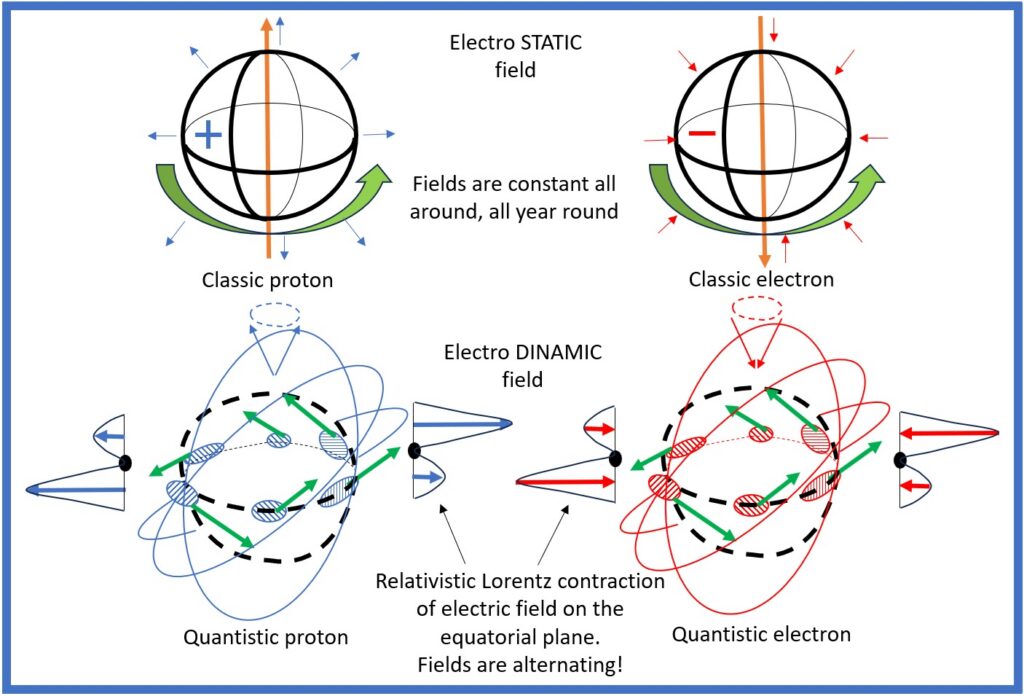
A proton, or an electron, aren’t exactly a plain sphere of uniform charge density gently rotating around their magnetic axis.
As things gets smaller, they also get quantistically hairy(er), meaning things begin to spin faster and faster and with indeterministical point like nature, meaning that the Lorentz contraction of the charge electric field on the atom equatorial axis becomes exponentially greater:

So whilst the total average charge of the proton or electron is well known and measured, the magnitude of the alternating electric and magnetic fields due to relativistic Lorentz contraction is order of magnitude greater than the plain electro STATIC field energy.
Could this alternating electric field account for the entirety of the gravitational mass/field energy of the proton and electron?
OBJECTION: Neutron has no charge and yet it has a gravitational mass, how is that possible?
Truth is, the neutron is a neutral particle at long range, like a hydrogen atom, but what is a neutron made of in reality?
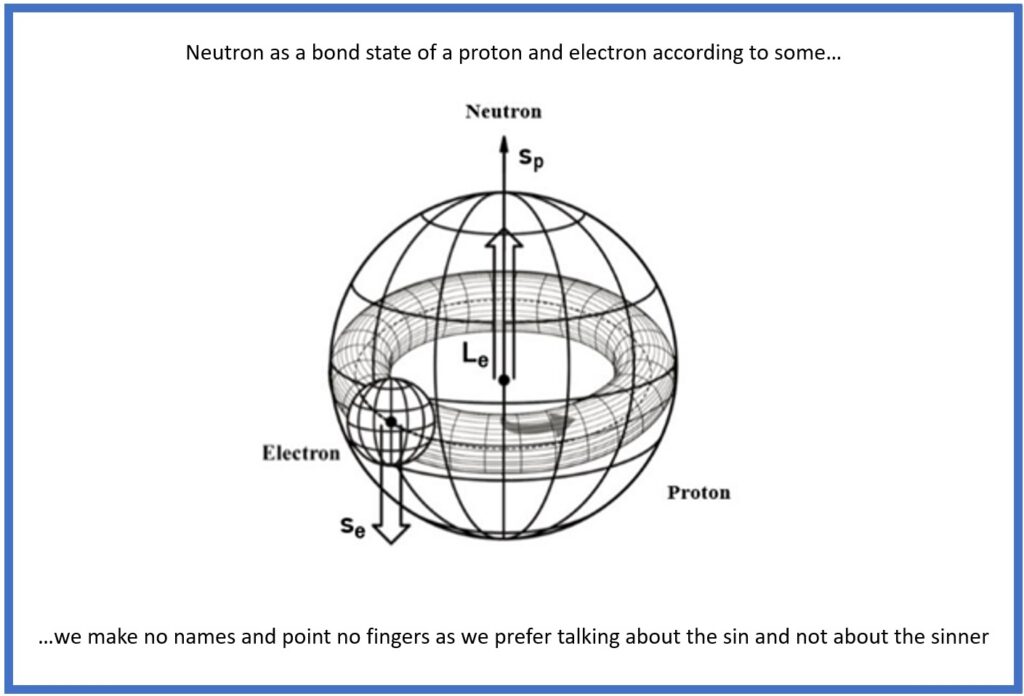
Academic career safety not guaranteed
OBSERVATION 4: One fun way to warp a rotating dipole radius (and hence its gravitational characteristics) is to apply a strong magnetic field so to cause its intrinsic orbital radius to also change because of Lorentz forces stretching or compressing the ground state orbital radius.
Question being: Could a magnetic field be strong enough to “squish” a proton or better a neutron hard enough, like a rubbery stress ball, hence inducing a significant change in his charge orbital radius to the point that its inherent magnetic moment is also slightly changed?
Also can you tell what is inherently wrong on the picture below/right image?

In any case, back in the 80s a team from Quebec stumbled across this puzzling result when doing some experiments with neutrons and then measuring their spin.
General populace and movie goers at large might not be at all feel upset or excited if a proton or neutron in certain strong field conditions changes its magnetic moment by a bit.
However in academic circles such an observation would be revolutionary, because the entirety of quantum mechanic is based on the invariance of fundamental particle properties and if these fundamental values are no longer constant but can be changed or tweaked, well the entirety of quantum mechanic formulations of the past 100 years would have to be re-written along with the brains of physics teachers who have been taught the same script and lines for pretty much the same amount of time.
In fact the team who discovered almost by chance this puzzling phenomena did try to publish the paper in Physical Review Letter / APS Journal.
However the editorial team at PRL decided not to publish that paper, but instead sat on it for the longest time (like 18 months), tipped some friends at Los Alamos laboratory to re-create the troublesome experiment and submit a paper that would disprove the original one, and the first one was flagged down as “ERRATUM”.
So the editorial team acted like a referee, deciding which paper and scientific results are OK to publish and which ones are wrong…
In fact it appears that the Quebec team did try to meet with the Los Alamos team to verify the experimental apparatus setup and converge toward a clear resolution of whose experimental results are correct and which ones are off. Reportedly the Alamos team seemingly had more pressing and urgent matters to pursue and could spare no time for the resolution of the discrepancy.
Eventually the Quebec team politely said “fuck you!” to the PRL and got its paper published at last in Europe. They eventually managed to repeat the same experiment with even greater accuracy later on, but still with some necessary rewording on the title to avoid triggering certain professors on a very “polarizing” issue…
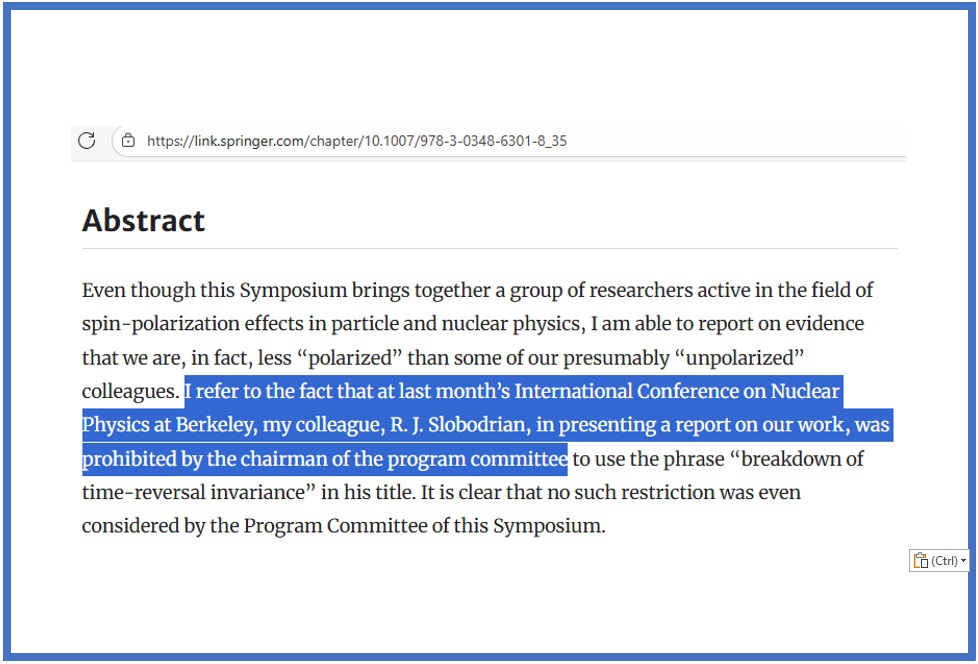
Albeit this might seem an idle discussion, it has profound implication on the physical word we live in and it is a testament of division and scientific clarity within the academia with the following disheartening results:
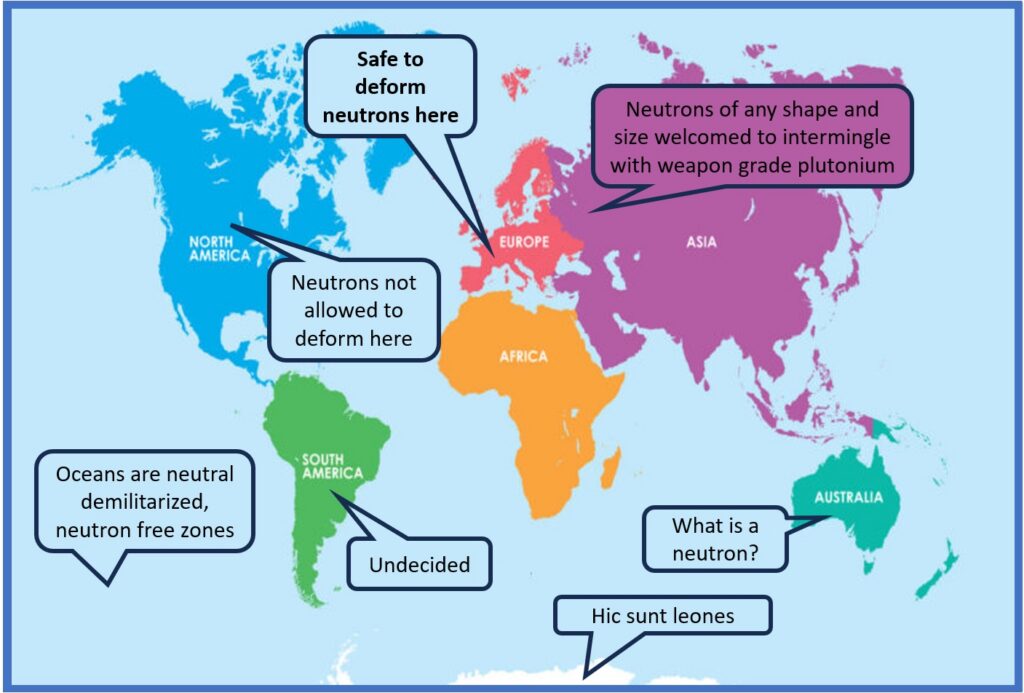
Fasten your seatbelts and float away safely toward your doom
Finally we get to play with some theorical gravitational machines.
We could derive gravitational attraction or repulsion from electric (or magnetic) dipole type interaction and different frequency responses, or even through electrophoresis style formulas based on gradient of electric field, which become very relevant as we approach the edge of the gravity emitter particle/dipole.
Some of the formulas we were able to scavenge, for a relativistic rotating electric dipole, the gravitational mass component can be expressed as:

For a rotating magnetic dipole in opposite direction configuration the gravitational mass component can be expressed as:

With N1 and N2 being geometry specific factors, in this case being 4 and 144 respectively without providing any reference whatsoever as to why of these numbers.
And in the case we are dealing with man made gravitational machines where we can’t spin charges or magnets at relativistic speeds, the formulas become:
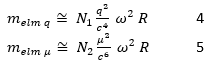
In any case it is obvious that using magnetic fields to craft gravitational fields is possible, however the gravitational fields at play will be in general much weaker than the equivalent gravitational filed generated by means of electric dipoles.
To note that the first explorer of gravity through magnetic fields was probably Eugene Podkletnov, who first stumbled by chance into a rare “2% gravity shielding effect” linked to a rotating superconductor and magnetic field effects.

Again the effects appear to be small and the experiment complexity high, requiring high currents and superconductors to produce minute gravitational effects, meaning we should refrain from using magnetic fields to craft gravitational ones for all practical purposes, but potentially an intense magnetic field could prevent an object atoms and electrons from polarizing in the Earth gravitational (polarizing?) field direction so the mass would experience less gravity?
Even more intriguing (rumored) experiment by Podkletnov was to use a superconductor in a spark gap setup which would yield a gravity pulse in the direction of the spark leaving the superconductive cathode.
We are usually pretty good at figuring out the root cause of certain discoveries or experiments but in this specific case the big mystery is: How the heck did he come up with the idea for this experiment?
It does not appear that the research group leading this had any workable theorical formulations of these gravitational effects, so how did the evolutionary experimental jump come here?
Some interesting takeaways and speculations about this experiment and their claimed results.
A “gravity pulse beam” is produced when the spark ignites from the superconductive cathode.
This “beam” is visible to the scientists present during the experiment, meaning that whatever it is, it must be interacting somehow in an electromagnetic way, possibly being mediated by air atoms and secondary energy re-emission of light visible to operators?
The “beam” passes through objects and walls and causes a gravity pulse that knocks the objects over or makes them oscillating if hanging on a pendulum.
Possible explanation is that likewise normal light causes the photons of our hydrogen atom to get excited at greater orbital radiuses thus causing greater electric field variations, likewise there must be a novel type of “magnetic radiation” which does not force the hand of the electron energy content, but instead forces the “magnetic moment” of said electron, forcing it to wander at greater orbitals without actually possessing the required energy for that jump.
This would result in a sort of “cold electron”, orbiting the atom at aberrated magnetic moments/radiuses at lower than expected energy bands.
The Internet out there is in fact riddled with “cold energy” predicaments of spark gap systems leaving conductors colder than they should…
We shall not venture further into details of these magnetic based spark gap technologies and claims but we chose instead to focus on more serious gravity machine experiments such as:
Tesla death ray machine!
OK, maybe yet another urban legend of the Internet but we still want to give it a “shot” (pun intended!) in the light of the recently re-discovered gravity field equations.
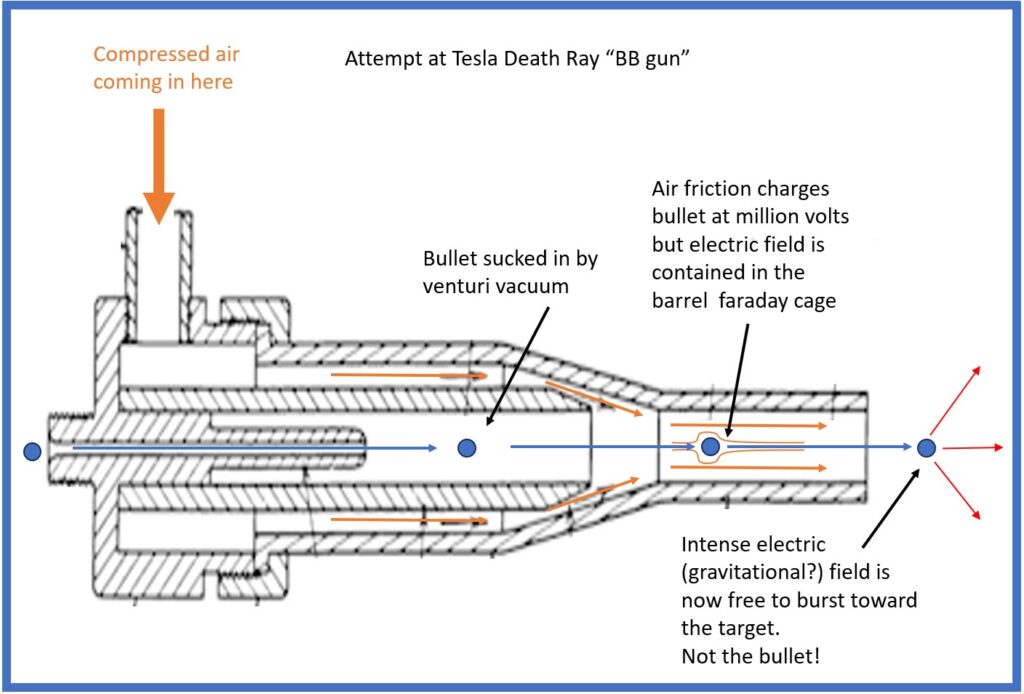
The proposed schematic aims at shooting small pellets through a venturi tube using high pressure air as the mechanical media to achieve pellet kinetic energy.
However the true purpose of such glorified BB gun was not to shot down planes kinetically with bullets, but to basically use air friction to charge the pellets at millions of volts.
As soon as the pellets exits the barrel, they are no longer electrically shielded inside the faraday cage/barrel of the gun and they are free to radiate an extremely intense electric field which will soon decay as the pellet corona discharges with nearby free air.
So here we have a high intensity pulsed electric fields being shot at objects in the sky.
Was it trying to shoot gravitational pulse fields toward incoming enemy planes?
Modern age gravity generators (?)
The idea is now to take formulas 4 and 5 and put them to work for us, ideally get us to go beyond energy conservation principle, whilst we shall ignore formulas 2 and 3 because we shan’t start spinning charges or magnets at relativistic speeds if we can avoid it.
In particular I will focus on Formula 4, which is to move charges around at high velocity and cause huge gradients of electric field so to induce gravitational effects on nearby objects.
In fact we are too lazy to move objects nowadays, and the best bang for your buck can be made by moving charges as opposed to moving charged objects.
Gravity generator 1: G sling
Somewhat similar concept of the Tesla quake machine, it consists in just 2 charge points being charged back and forth.
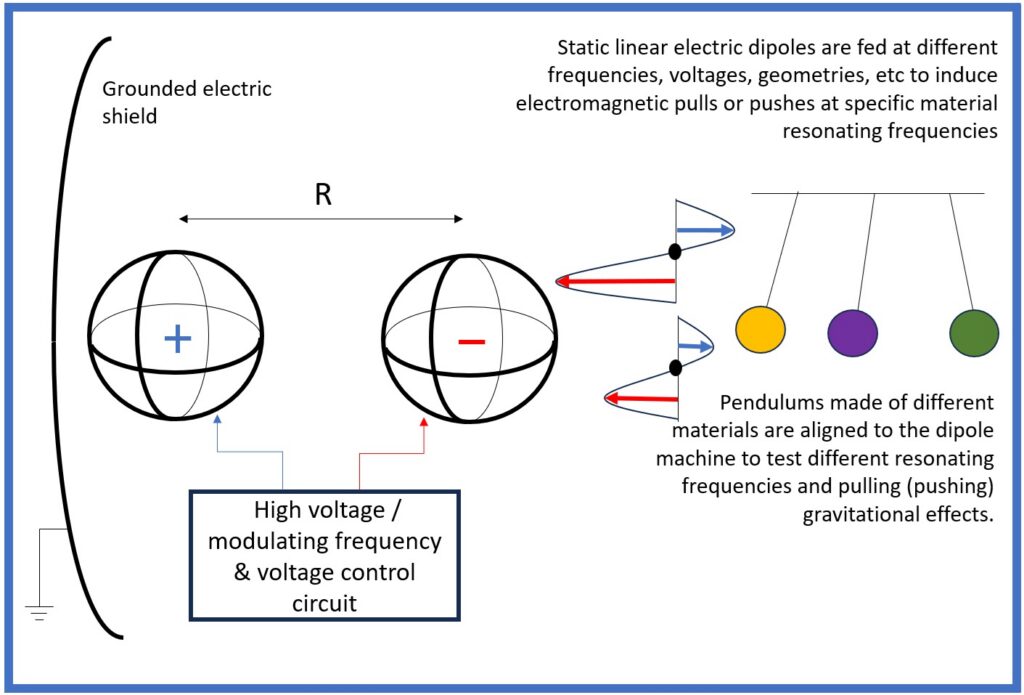
In this experiment we might want to use some spark gap discharges to pulse a static linear dipole in a certain voltage and charge sequence, whilst some pendulums made of different materials will be placed nearby and in line with our dipole axis to verify if an attraction or repulsion can be achieved.
See how we put a tick metallic shield behind it thinking that it might shield us from the electric fields and therefore gravitational pulses, but ultimately the shield atoms themselves cannot be shielded from interacting or resonating with alternating electric fields.
Also note that the “active” part of the gravitational field will push or pull objects aligned with the dipole, but object placed orthogonal to the dipole will suffer the wrath of the reactive part of the gravitational field and feel a urge to heat up, potentially catastrophically if the material resonating frequency is just right?
To note that said pulse generator will likely interact at an electron cloud level and is not likely to make to the million/billions hertz required to interact with the more massive proton and neutron dipole frequencies.
And yet if the pulsed linear dipole operates at a frequency exact multiple of the atomic nuclei frequency then intense effects might be achieved…
Gravity generator 2: G ring
This is similar to spinning physical dipole charges spinning at high speeds as discussed earlier, only we are not moving charged objects but the charges themselves within static objects.
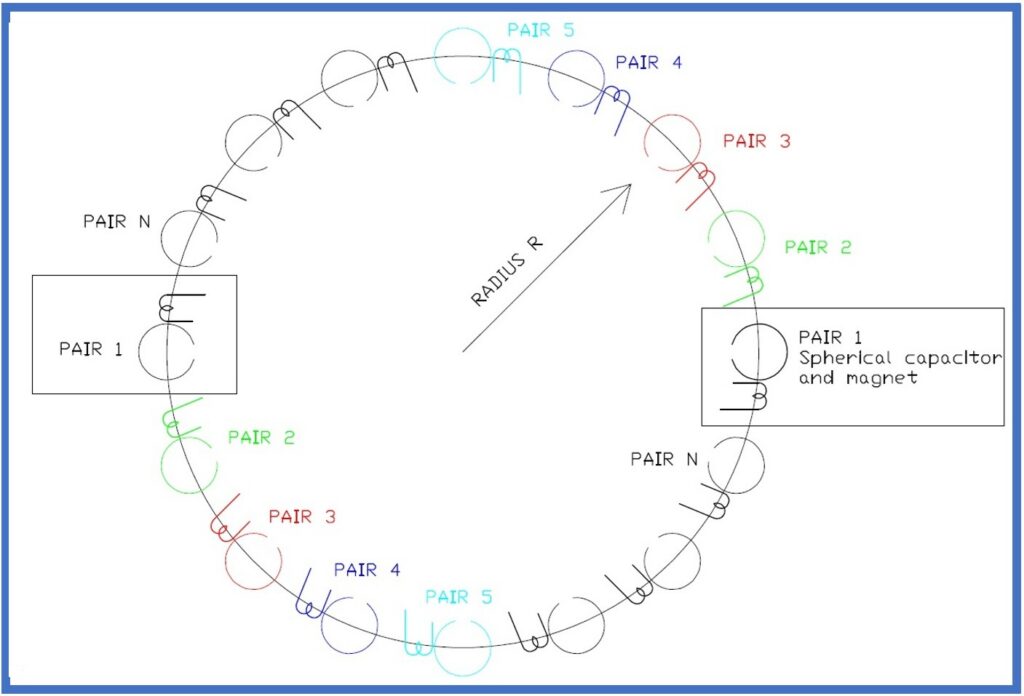
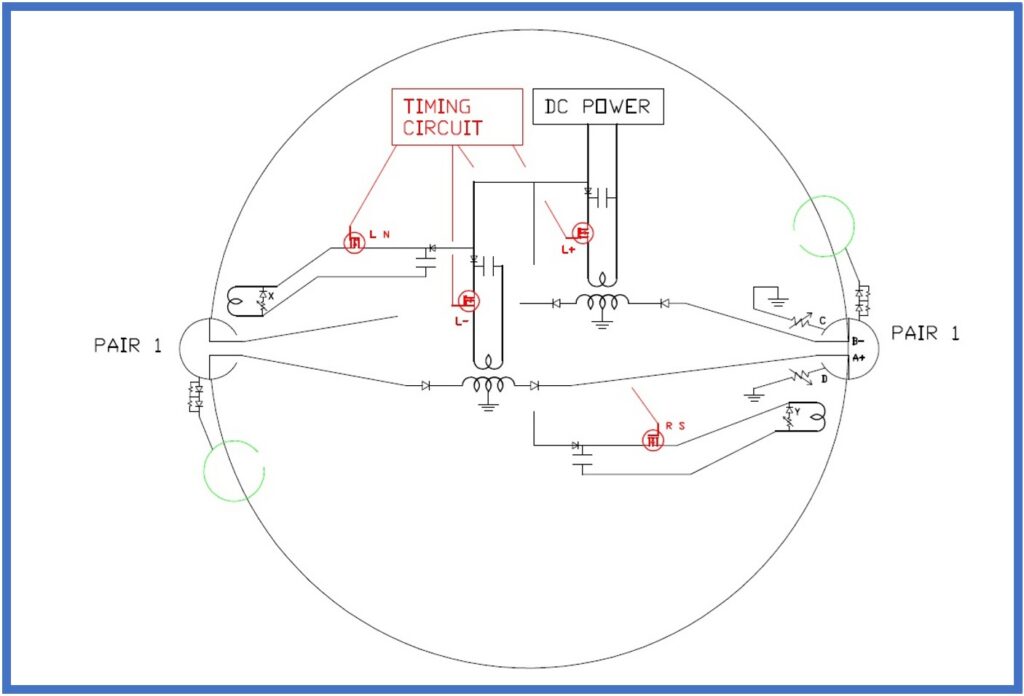
Advantage of this setup is that our dipole can be meters/tens of meters in diameter, it can operate in the Kilo or Mega hertz depending how much power you want to push into the electronic, hence gravitational effects can be huge if formula 4 is correct…
Disadvantage of said experiment is that if proven right, then you might be receiving lots of angry phone calls from NASA and SPACE-X mission control for having knocked all their satellites out of orbit…
You are never truly alone when you suffer of persecutory delusions and paranoia
Being true to the ethos of our previous statement, we hereby strongly reprimand the CCP against the weaponization of gravitational tech for warfare applications, but instead encourage them to develop civil applications first, ideally share with the rest of us when you get a chance?
We have in fact mobilized powerful geopolitical simulation resources at the Foundation (?) to play out different simplified gravity tech warfare scenarios by means of renowned board game “SELFISH – SPACE EDITION”.

Whilst the true nature of future historical events to come remain open to last minute changes and decisions, future scenario simulations suggest a “War of the Roses” probabilistic development in which there is no winner, only different degrees of loss.
Sure enough history teaches us that all cool tech went through weaponization stages first (like message encryption and nuclear energy) and only later on new tech trickles down to civil applications, so we are not exactly holding our breath as of how things are more likely to develop.
We also want to reassure Chinese scientists that there is actually ZERO chance that the USA or Europe might frontrun you to this.
So just take your time, stay calm and do not step on gravity mines!
